

Table of Content
Intro
Digital transformation is defined as “the integration of new technologies in all areas of a company to change the way it operates, with the aim of optimizing processes, improving its competitiveness and offering new added value to its customers”. But, it is important to note that the implementation of such technologies alone will not be enough to generate a real transformation in the company. Understanding processes and using technological tools to optimize them is the key.
Since processes are paramount, here is a simple step-by-step methodology to address them from the digital transformation approach.
1. Initial Process Analysis
The first step is to perform an in-depth analysis of the processes currently in place in the company. With this analysis, a list of processes and their sub-processes should be developed in order of impact on the relationship with different stakeholders receiving the final products of the processes.
We will start with the processes that interact with the different users: customers, suppliers, collaborators and, finally, internal processes (processes without external interaction). To define these processes, think about the interactions your company has with each of these actors and what you expect to receive from them.
Once you have made the list, rate by the degree of interaction with the customer, supplier or collaborator, or according to the criticality of the process if it is an internal process. Rate each item on your list from 1 to 5, where 1 is Very Important and 5 is Not Very Important.
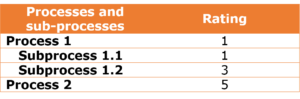
Now, with the processes rated, you can address those with ratings of 1 and 2, at first, and then you can evaluate the others. Continue to step 2.
2. Identifying the needs
Once the list of each of the actors who are clients of the processes is available, a list is made for each process describing the following items for each of them:
- Activities
- Approvals
- Documentation generated or required as input
- Interactions
- Comunications
- Reminders and alerts
- Status updates
The objective of this stage is to find and identify the points and forms of contact with third parties in order to make them more efficient and eliminate barriers.
In internal processes, it is necessary to look for points where operational cost savings can be obtained.
During this analysis, to seek digital transformation, three crucial points must be identified:
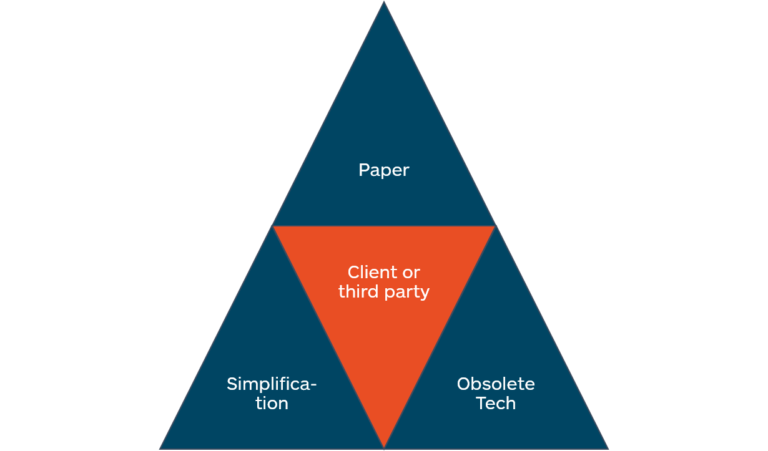
- Existence of paper. Objective → Eliminate and replace with digital
- Obsolete technology. Objective → Update
- Simplification. Objective → Eliminating redundant, unnecessary or obsolete processes
Below is a simplified diagram of how these processes might look like.
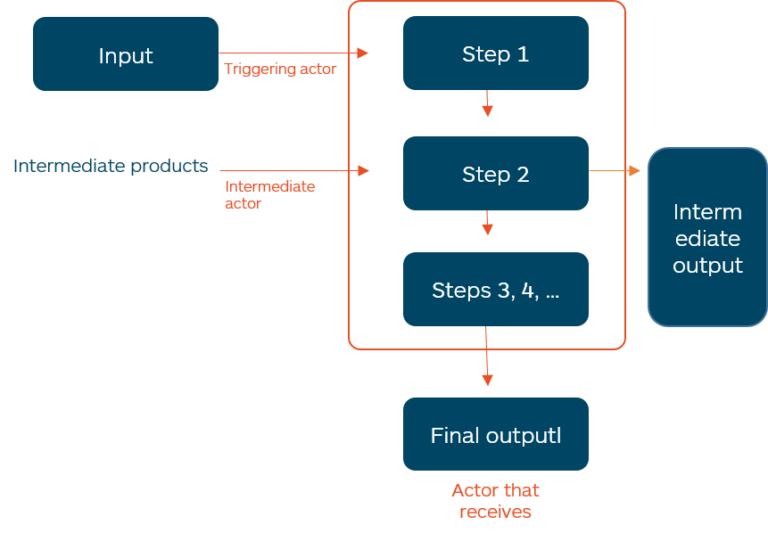
As shown in Figure 2, each process flow contains:
- Input product(s) of the process.
- Actor that triggers the process.
- Intermediate products generated by the process.
- Intermediate actors to which the process is related and by means of which product.
- Final product generated by the process.
- Actor that collects the final product of the process.
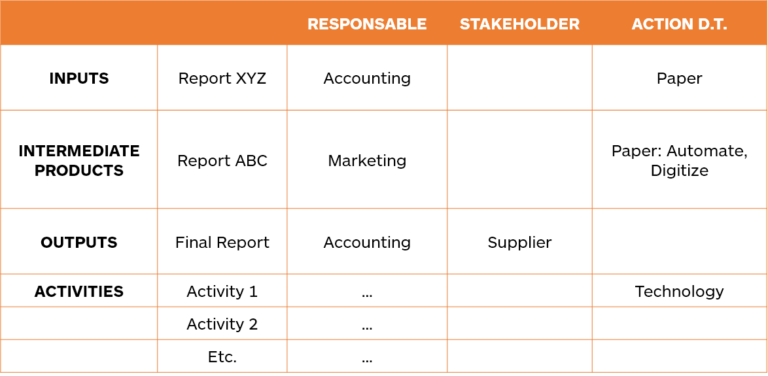
One way of structuring this stage is shown in Table 2.
3. Prioritization
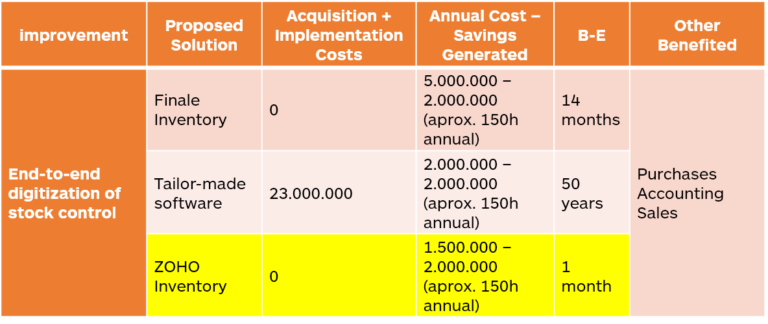
Once the list of improvements and necessary actions in the activities, products and process relationships is clear, the prioritization continues. This is based on looking for quick-wins: improvement actions that require little effort in time and resources, and that have an immediate return both in terms of improved interactions (times, errors, bottlenecks) and costs (direct and indirect cost reductions).
For each improvement, an action plan is determined, containing:
- List of possible technological solutions to be applied
- Cost of each possible technological solution (start-up, annual operating cost with licenses, maintenance, etc.).
- List of processes/actions that could benefit from the same solution.
- Cost of implementation and adaptation
- Estimated start-up time
- Estimated cost savings and breakeven points
- Road-map for implementation of the technology solution
4. Communication & Information
For each solution, a communication plan should be developed for all stakeholders, indicating the reasons and need for the change, expected benefits, time required for implementation and the high-level project plan.
Along with the communication plan, a training plan should be developed for those involved:
- Users training
- Technology training
It is important that those involved are part of the solution implementation and testing team from the very beginning.
5. Implementation
Once the solution has been selected, the budget has been assigned, and the acquisition or start of the project has been approved, a team must be formed to carry out the tasks. For this purpose, a Project Manager and a Product Manager must be appointed. The former is responsible for the project implementation, development, process adaptation and branding, managing the assigned budget, the work team, the schedules and the result. The second is responsible for the solution once implemented and will be in charge of the evolution of the solution, its adaptations, maintenance and evolutions during its useful life.
6. Launching
This final phase must be accompanied by:
- Internal and external communication plan
- Special support team
- Gradual deployment
Conclusion
This methodology simplifies a complex analysis and execution process. It requires the support of the company’s management team, and there must be personnel responsible for these processes.
In an analysis process, the important thing is to focus on defining the quick-wins. In the execution process, communication and training processes that seek to counteract resistance to change, which is very common in these transformations, are of great help.